


Table of contents
- Introduction
- Injection Molding Machine Price Range in 2026
- Price by Tonnage and Machine Type
- What Is Included in a Machine Price?
- How Much Does an Injection Molding Machine Cost by Tonnage?
- How Machine Type Affects Injection Molding Machine Price
- What Factors Affect Injection Molding Machine Price?
- What Additional Costs Should Buyers Budget For?
- Injection Molding Machine Price vs. Total Cost of Ownership
- How to Compare Injection Molding Machine Quotes
- New vs. Used Injection Molding Machine Cost
- How to Choose an Injection Molding Machine for Your Budget
- Why Consider LOG Machine for Injection Molding Equipment?
- Conclusion
Introduction
The injection molding machine price can range from tens of thousands of dollars for smaller production machines to several hundred thousand dollars or more for large, highly configured systems. The final quotation depends on clamping force, injection capacity, machine type, speed, precision, automation, components, and the scope of supply.
For B2B buyers, the most useful question is not simply “How much does an injection molding machine cost?” It is “What machine configuration is required, what should it cost, and what additional investment will be needed before production starts?”
This 2026 guide explains current price benchmarks, how tonnage and machine type affect cost, which factors can change a quotation, and how buyers can compare injection molding machine quotes more effectively.
Injection Molding Machine Price Range in 2026
There is no single market price for an injection molding machine because machines with the same nominal tonnage can have very different configurations. Current 2026 public-market guides place new industrial machines broadly from roughly $25,000–$65,000 for smaller hydraulic equipment, $50,000–$220,000 or more for many mid-range production machines, and $150,000–$1,000,000+ for larger or highly configured systems. These are planning ranges rather than fixed manufacturer quotations, and different sources use different machine specifications and scopes of supply.
| Machine Category | Indicative 2026 Price Range | Typical Applications |
|---|---|---|
| Small Hydraulic | $25,000–$65,000 | Small plastic parts, general molding |
| Servo-Hydraulic | $50,000–$220,000+ | General industrial production |
| High-Speed | $80,000–$300,000+ | Packaging, thin-wall and high-volume molding |
| All-Electric | $55,000–$325,000+ | Precision, medical and electronics |
| Large-Tonnage | $150,000–$1,000,000+ | Automotive, large parts and industrial production |
These figures should be used for initial budget planning only. They do not represent a universal market price. A machine quotation can change significantly based on clamping force, shot size, drive system, automation, control components, mold requirements, delivery terms and optional equipment. TUP’s current B2B cost guide similarly emphasizes that the complete investment can include the machine, options, auxiliaries, freight, installation, commissioning and other project costs.
Price by Tonnage and Machine Type
Clamping force is one of the most visible factors affecting the injection molding machine price, but tonnage should not be used as a standalone pricing formula.
For example, a 200-ton servo-hydraulic machine, a 200-ton high-speed machine and a 200-ton all-electric machine may have substantially different prices. Buyers should therefore compare the complete machine specification rather than simply comparing the number printed next to “ton.”
What Is Included in a Machine Price?
A quotation may include the base machine and standard configuration, while special screws, additional injection units, robots, temperature-control equipment, customized controls or other auxiliary systems may be optional.
International buyers should also check whether installation, commissioning, training, spare parts, packaging and transportation are included. A lower headline price does not necessarily mean a lower total investment.
How Much Does an Injection Molding Machine Cost by Tonnage?
Tonnage normally refers to the machine’s clamping force. Larger machines generally require larger frames, clamping units and injection systems, which increases equipment cost. However, the relationship is not linear because machine architecture and application requirements also change as machine size increases.
Under 100 Tons
Smaller machines are commonly used for relatively small molded parts, connectors, household products and other applications with limited projected area and shot requirements.
At this size, buyers should look beyond the purchase price and confirm shot size, mold dimensions, material compatibility and cycle-time requirements. A lower-priced machine is not economical if its injection capacity is insufficient for the intended product.
100–400 Tons
This is an important range for general industrial production, including consumer products, packaging components, household products and various industrial plastic parts.
The machine type can create significant price differences within this range. LOG’s S8 servo injection molding machine includes models starting around 110 tons, while its A8E variable-pump range starts at 90 tons.
400–1,000 Tons
Larger machines are more suitable for products requiring larger molds, greater clamping force and higher production capacity. Typical applications can include automotive components, containers, industrial housings and larger consumer products.
At this level, buyers should compare clamping force together with injection volume, platen dimensions, mold space, injection pressure, speed and automation.
Over 1,000 Tons
Large-tonnage equipment represents a different investment category. These machines are used for large automotive components, pallets, containers, industrial parts and other applications requiring substantial clamping capacity.
At this level, the injection molding machine price is highly configuration-dependent. Public pricing guides also show that large machines can move into several-hundred-thousand-dollar or million-dollar project territory depending on machine design and scope.
For this reason, project-specific quotations are more useful than generic online pricing.
How Machine Type Affects Injection Molding Machine Price
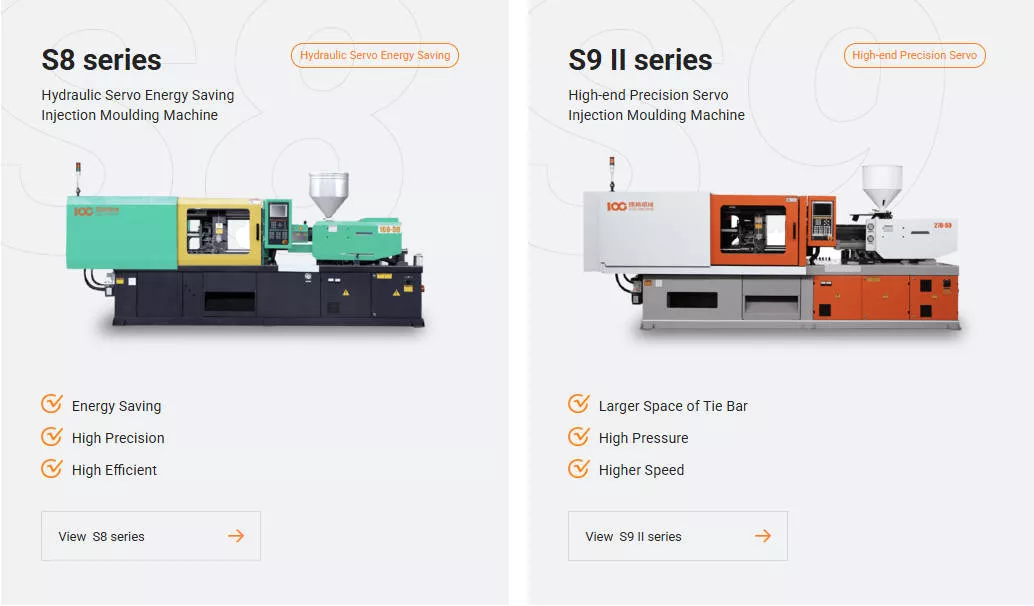
Machine architecture is one of the main reasons two injection molding machines with similar tonnage can have different prices.
Hydraulic Injection Molding Machines
Conventional hydraulic machines remain widely used because they offer a practical balance between equipment cost, versatility and production capability.
For general-purpose applications without unusually demanding speed or precision requirements, hydraulic machines can provide an economical starting point. However, buyers should evaluate energy consumption, maintenance, production cycle and expected annual operating hours alongside the initial price.
Servo-Hydraulic Injection Molding Machines
Servo-hydraulic machines combine hydraulic molding systems with servo-driven control technology. They are commonly selected when manufacturers want improved energy performance and machine control without moving completely to an all-electric architecture.
LOG’s S8 servo injection molding machine is positioned as an energy-saving hydraulic servo machine and covers a broad range of clamping-force configurations.
Variable-Pump Injection Molding Machines
Variable-pump machines use a hydraulic system designed to better match pump output with actual production requirements.
LOG’s A8E variable-pump injection molding machine is positioned around power saving, reliability and practical operation, with configurations starting from 90 tons and extending into larger tonnage ranges.
High-Speed Injection Molding Machines
High-speed machines are designed for applications where injection speed and cycle efficiency are particularly important. Packaging and thin-wall products are common examples.
LOG’s CP high-speed injection molding machine covers clamping-force configurations from 60T to 550T and is positioned for applications including automotive precision parts, medical products and food packaging.
All-Electric Injection Molding Machines
All-electric machines generally require a higher initial investment because of their electric drive architecture. They can be attractive where precision, repeatability, clean operation and efficiency are important purchasing criteria.
LOG’s AD-T all-electric injection molding machine includes 30T, 55T, 80T, 110T, 140T and 185T configurations and is positioned around stable injection performance, efficiency and water-saving characteristics.
What Factors Affect Injection Molding Machine Price?
Machine type is only one part of the pricing equation. Several technical and commercial variables can materially change the final quotation.
Clamping Force
Clamping force determines the machine’s ability to keep the mold closed during injection. It is related to the projected area of the molded part, cavity pressure and processing conditions.
LOG’s guide to how to calculate injection molding machine tonnage explains the relationship between projected area, cavity pressure and required clamping force. Choosing an unsuitable tonnage can increase both purchase and operating costs.
Injection Capacity and Shot Size
The injection unit must provide enough capacity for the required part, runner system and material. Shot size should therefore be evaluated together with the product’s weight and processing requirements.
A machine that is too small can limit production, while an unnecessarily large injection unit can increase investment without providing useful additional capacity.
Drive and Injection System
Hydraulic, servo-hydraulic, variable-pump and all-electric systems use different mechanical and control architectures. These differences affect both initial price and long-term operating characteristics.
The right choice depends on whether the priority is low initial investment, energy efficiency, speed, precision, or a combination of these factors.
Injection Speed and Cycle Time
Production volume can make cycle time a major economic factor. High-speed machines generally require configurations designed for faster injection and demanding production cycles.
When a machine operates for many hours per year, a higher initial investment may be justified if it improves output and overall production economics.
Precision and Repeatability
Applications such as medical components, electronics and precision parts may require tighter control and repeatability.
Higher precision can affect the drive system, injection unit, controls and overall machine configuration, which may increase the equipment cost.
Automation Level
Automation can include part removal, material feeding, inspection, conveying and other production-line functions.
A highly automated molding cell generally requires greater upfront investment, but it can reduce labor requirements, improve process consistency and support higher-volume production.
Control System and Components
Controllers, servo systems, hydraulic components, electrical systems and other major components can vary significantly between suppliers.
For that reason, buyers should compare actual specifications rather than assuming two machines with similar tonnage are equivalent.
Customization and Special Configurations
Special screws, customized injection units, additional hydraulic functions, automation integration and application-specific modifications can all affect the quotation.
Manufacturer and Service Support
Supplier capability also affects the practical cost of ownership. Technical support, spare-parts availability, installation, commissioning and after-sales service should be evaluated together with the machine’s initial price.
What Additional Costs Should Buyers Budget For?
The quoted machine price is only one part of the total investment required to start production.
Mold and Tooling
Mold cost is separate from machine cost and can vary according to cavity count, part geometry, material, complexity and required finish.
The important point for machine buyers is to make sure the selected machine can accommodate the mold correctly in terms of dimensions, clamping force and injection requirements.
Auxiliary Equipment
A complete molding operation may require dryers, chillers, material loaders, temperature controllers, granulators, robots or other peripheral systems.
Buyers should confirm which accessories are included in the machine quotation and which must be purchased separately.
Shipping and Import Costs
For international buyers, the manufacturer’s equipment price is not necessarily the final landed cost.
Transportation, export documentation, freight, insurance, customs duties, taxes and local handling can all affect the total amount paid.
Installation and Commissioning
Installation can involve electrical connection, machine setup, process adjustment and commissioning support.
Whether these services are included should be clearly stated in the quotation before suppliers are compared.
Spare Parts and Training
Initial spare parts and operator training may also form part of the project budget. Clarifying availability and technical support before purchasing can reduce future downtime.
Injection Molding Machine Price vs. Total Cost of Ownership
A low purchase price does not automatically represent the lowest-cost molding solution.
For a production-oriented buyer, total cost of ownership should include the initial equipment investment as well as energy, maintenance, spare parts, downtime, labor and machine utilization.
| Cost Factor | What Buyers Should Consider |
|---|---|
| Purchase Price | Initial equipment investment |
| Energy | Electricity consumption during production |
| Maintenance | Preventive service and spare parts |
| Downtime | Lost output during equipment failures |
| Labor | Operator requirements and automation |
| Service Life | Long-term reliability and replacement needs |
Energy efficiency can be particularly important for machines operating for long production hours. However, buyers should evaluate energy-saving claims using the actual machine configuration, operating cycle and production conditions rather than assuming that every machine in the same category provides the same savings.
The same principle applies to maintenance and productivity. A machine with a higher initial price may provide better economics over time if it delivers suitable energy performance, lower downtime and the required production output.
How to Compare Injection Molding Machine Quotes
When comparing suppliers, buyers should make sure they are comparing equivalent specifications and equivalent scopes of supply.
Compare the Same Machine Specifications
A 300-ton machine from two suppliers is not necessarily an equivalent product. Compare clamping force, shot capacity, injection pressure, injection speed, mold dimensions, drive system and major components.
Check What Is Included
Ask whether the quotation includes standard accessories, special components, automation, spare parts, documentation, training and other requested equipment.
This is particularly important when comparing an equipment-only quotation with a more complete production-cell quotation.
Confirm Delivery and Installation Terms
For international procurement, confirm the quotation basis and the responsibilities of both supplier and buyer.
Shipping, insurance, customs, installation and local electrical requirements can materially change the final investment.
Review Warranty, Service and Spare Parts
A machine should be evaluated beyond its purchase price. Buyers should ask about warranty coverage, service response, spare-parts availability and technical support after installation.
Compare Performance, Not Just Price
The lowest quotation may not be the most economical choice if it comes with lower production efficiency, higher energy consumption, limited automation or weaker service support.
The objective should be to compare cost relative to the required production performance, rather than simply selecting the cheapest machine.
New vs. Used Injection Molding Machine Cost
Used machines can reduce initial capital expenditure and may make sense for buyers with limited budgets, short-term production requirements or suitable maintenance capabilities.
However, buyers should evaluate machine age, maintenance history, control-system condition, spare-parts availability, previous operating conditions and remaining service life.
New machines generally provide greater flexibility for customization, current technology, warranty and long-term production planning.
For international buyers, another important distinction is the difference between the machine’s factory price and its landed cost. Used-equipment guides also emphasize that EXW pricing does not necessarily include freight, customs, installation or other delivery-related costs.
How to Choose an Injection Molding Machine for Your Budget
Budget should be considered together with production requirements rather than used as the only selection criterion.
Define the Product and Material
Start with the molded product, plastic material, part weight and quality requirements. Different materials and products can require different injection pressures, shot capacities and processing conditions.
Calculate Required Clamping Force
Use the projected part area, material and process requirements to establish an appropriate clamping-force range.
Determine Shot Size and Injection Capacity
Make sure the injection unit can handle the required shot weight and provide suitable process margin for the part and runner system.
Match Production Volume
High-volume production may justify servo, high-speed or automated equipment when cycle time, energy performance and labor efficiency have a meaningful effect on production economics.
Consider Operating Costs
Compare expected energy and maintenance requirements, not just the initial purchase price.
Plan for Future Expansion
Buying significantly more capacity than required can increase capital and operating costs, while choosing too little capacity may create production bottlenecks.
For a more detailed machine-selection process, see LOG's guide to selecting a plastic injection molding machine.
Selecting a Plastic Injection Molding Machine Guide
Explore LOG's step-by-step framework covering clamping force calculations, shot capacity matching, mold space checks, and machine-type comparisons to help you choose the right injection molding solution.
Why Consider LOG Machine for Injection Molding Equipment?
LOG Machine provides several injection molding machine categories for different production requirements. Its current injection molding machine product portfolio includes servo, variable-pump, high-speed and all-electric machines.
Servo Injection Molding Machines
LOG’s S8 series covers a broad range of clamping-force configurations, providing options for both smaller and larger production requirements. Buyers looking for servo-hydraulic equipment can evaluate the S8 series according to product size, mold requirements and production volume.
Variable-Pump Injection Molding Machines
The A8E series uses variable-pump technology and is positioned around energy saving, reliability and practical operation. With models starting at 90 tons, the series can serve a range of general industrial molding requirements.
High-Speed Injection Molding Machines
LOG’s CP series covers 60T–550T configurations and is designed for applications where injection speed and production efficiency are important. Its stated application areas include automotive precision parts, medical products and food packaging.
All-Electric Injection Molding Machines
The AD-T series provides an all-electric option for applications where stable injection performance, precision and efficiency are important considerations. Available configurations include 30T, 55T, 80T, 110T, 140T and 185T.
Application-Oriented Machine Selection
LOG also organizes its injection molding solutions around application areas including packaging, medical products, auto parts, white appliances, communication electronics and daily necessities.
For buyers comparing equipment, this broader product structure can make it easier to match machine type, tonnage and application requirements instead of selecting a machine based only on its advertised purchase price.
Conclusion
The injection molding machine price depends on much more than machine tonnage. Machine type, clamping force, injection capacity, speed, precision, automation, components and customization can all affect the final quotation.
For B2B buyers, the better approach is to compare the complete machine specification, quotation scope and total cost of ownership rather than selecting the lowest initial price. A clear understanding of the product, material, mold and production requirements also makes it easier for a manufacturer to recommend the right configuration.
For buyers evaluating new injection molding equipment, contact LOG Machine with the product, material, production volume and machine requirements to obtain a project-specific recommendation and quotation.
