


Table of contents
Introduction
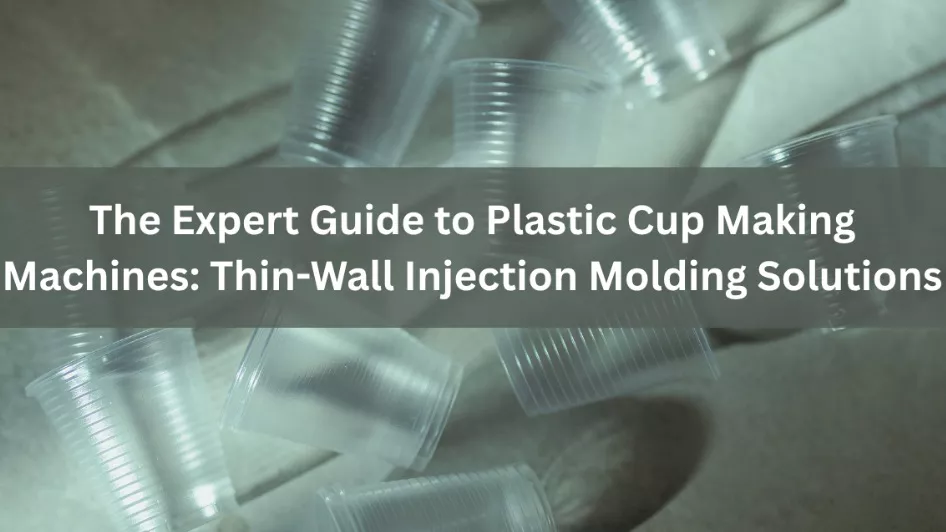
In the highly competitive global food packaging and beverage industries, manufacturing thin-wall plastic cups (such as disposable PP tea cups, milk tea cups, and lightweight airline cups) is a game of milliseconds and micrometers. With wall thicknesses frequently dropping below 0.5mm to reduce material costs and minimize environmental impact, standard plastic injection equipment is no longer viable.
What Makes a Great Cup Machine?
To the untrained eye, all injection molding machines look similar. However, the internal engineering of a dedicated thin-wall plastic cup making machine is radically different. To withstand the immense physical pressures of rapid-cycle packaging production, several technical metrics must be meticulously optimized:
1. High Injection Speed and Instantaneous Response
Thin-wall products require extremely fast injection speeds, often ranging from 300mm/s to over 800mm/s.
2. High Clamping Force and Platen Rigidity
When high-pressure molten plastic is injected at extreme speeds, it exerts a massive expansion force inside the mold cavity.
3. Optimized Screw L/D Ratio
The plasticizing screw must melt material rapidly and evenly. For materials typical to cup manufacturing (such as PP, PS, and PET), a screw with a specialized aspect length-to-diameter (L/D) ratio (typically between 20:1 and 22:1) is essential to ensure excellent melt homogeneity and consistent shot-weight control.
Key Technical Comparison: Standard vs. Thin-Wall Cup Machines
| Parameter | Standard Injection Molding Machine | High-Speed Thin-Wall Cup Machine |
|---|---|---|
| Injection Speed | 50mm/s - 100mm/s | 300mm/s - 600mm/s |
| Injection Pressure | 100 - 140 MPa | 180 - 240+ MPa |
| Cycle Time (Plastic Cup) | 12seconds - 20seconds | 3 seconds - 6 seconds |
| Platen Construction | Standard cast iron | Thickened, high-rigidity platens |
| Hydraulic System | Standard pump | Accumulator + Servo system |
How to Choose Your Machine
Choosing the right machine size and specification is critical to ensuring long-term return on investment (ROI). Below is the technical step-by-step approach used by procurement experts to size their machinery:
Step 1: Calculate the Shot Weight and Cavity Design
First, determine the weight of a single plastic cup and multiply it by the number of cavities in your mold, then add the weight of the runner system.
For maximum process stability, the total shot weight of your cup mold should fall between 30% and 70% of the machine’s maximum theoretical injection capacity.
Step 2: Calculate the Required Clamping Tonnage
To prevent mold parting line separation during the high-pressure injection phase, you must calculate the minimum clamping force (F). This is calculated by multiplying the total projected surface area (A) of all cups (including runners) by the average cavity pressure (P):
F=P×A
-
Average Cavity Pressure (P):
For thin-wall PP/PS cups, cavity pressure typically ranges from 35MPa to 60MPa (350bar - 600bar), depending on the flow length-to-wall thickness ratio (L/T). -
Projected Area (A): The maximum surface area of the cup when viewed from the direction of mold opening.
- Example: If your mold has a total projected area of 400cm² and requires a cavity pressure of 45MPa, the required clamping force is: F = 45MPa × 0.04m² = 1800kN (Approx. 180Tons)
Adding a standard 10% safety margin ensures you need a machine with at least 200Tons of clamping force.
Step 3: Analyze Cycle Time and Cooling Efficiency
Thin-wall cup manufacturing relies heavily on lightning-fast cooling. Since plastic cups have ultra-thin profiles, they cool quickly, but the machine must support this pace with high-speed dry cycles (fast mold open/close movements). Look for machines featuring specialized high-response servo valves and high-speed pneumatic or hydraulic ejectors to blow the cups off the mold cores instantly.
Step 4: Evaluate Energy Efficiency and Power Dynamics
Because these machines run continuously (24/7), power consumption constitutes a massive portion of operating costs. Traditional hydraulic machines run pumps at constant speeds, wasting immense amounts of energy during the cooling and idle stages. Modern cup manufacturers should look for machines outfitted with advanced closed-loop servo-driven hydraulic systems, which scale motor output dynamically to match the actual stage of the molding cycle.

Solving Common Molding Problems
When running thin-wall cycles at sub-5-second speeds, minor process imbalances can lead to high defect rates. Here are the three most common thin-wall cup manufacturing defects and how advanced machinery resolves them:
Short Shots (Incomplete Cups):
- Cause: The molten plastic loses its temperature too quickly before reaching the end of the cup rim, or the machine's maximum injection pressure/speed is insufficient.
- Solution: Transition to a machine equipped with a nitrogen-charged hydraulic accumulator. This allows for high-pressure, high-speed injection, forcing the melt to fill the entire cavity in a fraction of a second.
Flashing (Excess Material on Edges):
- Cause: The high internal cavity pressure physically pushes the mold plates apart due to platen bending or insufficient clamping force.
- Solution: Utilize machines built with finite element analysis (FEA) designed platens. Increased center thickness and reinforced hinge structures distribute clamping force evenly across the mold face.
Cup Warpage and Deformation:
- Cause: Uneven cooling or high residual stress in the plastic caused by poor mold packing.
- Solution: High-precision servo controllers allow for millisecond-level transitions from the injection phase to the holding pressure phase, ensuring uniform density without packing the gate too tightly.
Why Choose LOG Machine?
For global packaging manufacturers seeking robust, highly customizable, and energy-efficient equipment to build high-output cup production lines, Log Machine (Ningbo Chuangji Machinery Co., Ltd.) is the premier partner of choice. Established in 2007, LOG Machine has grown to operate a state-of-the-art 100,000m² manufacturing facility with an annual capacity of over 4,000 sets of precision injection molding machines.
With over 120 invention patents and a global network of 20+ distributors and service stations, LOG Machine operates under a distinct engineering philosophy: "Customized-made, be unique and different." They specialize in tailoring their injection molding machinery to the exact molds, materials, and spatial requirements of their B2B clients.
Recommended Machinery: The LOG S8 & S9 II Servo Series
LOG’s flagship series are widely utilized in global packaging factories for high-yield food container and cup production:
- High-End Precision & Speed: The LOG S9 II Series features larger tie-bar spacing, higher injection speeds, and enhanced pressure profiles specifically optimized for complex, multi-cavity packaging molds.
-
Unmatched Energy Savings: Backed by LOG's advanced hydraulic servo energy-saving technology, the LOG S8 Series delivers remarkable thermal efficiency, saving between 45.5% and 80% of energy compared to traditional variable-displacement or fixed pump systems.
- High-Rigidity Clamping Units: To prevent the mold deflection and flashing common in thin-wall cup molding, LOG machines utilize optimized, heavy-duty mechanical clamping structures and thickened templates. This guarantees structural stability under intense, continuous, high-pressure cycles.
Real-World Application Example:
For standard disposable plastic cup production, the LOG-130S8 Servo Machine (featuring
$1300text{ kN}$ of clamping force) offers an ideal high-efficiency platform. Engineered with a high-torque screw and rapid-response servo system, it delivers highly repeatable, stable, and cost-effective cycles for multi-cavity thin-wall PS and PP cups.
Conclusion
In the high-speed world of thin-wall plastic cup manufacturing, your machinery is the foundation of your profitability. Minimizing cycle times by even half a second or reducing reject rates by $1%$ can translate into tens of thousands of dollars in annual savings for high-volume producers.
To maximize your operational efficiency, choose a machine built with the rigidity to prevent flashing, the injection speed to eliminate short shots, and the energy efficiency to lower your overhead. If you are looking to design, optimize, or scale a highly efficient plastic cup production line, consult the technical team at LOG Machine to explore their tailored, high-performance injection molding solutions.
Ready to elevate your packaging production? Visit Log Machine today to connect with a factory engineer and request a customized project quote.
